Father Fagan Park is a small triangular area in Soho along 6th Avenue. It is bordered by Prince Street to the north and runs about midway down a long block until the spot where Vandam Street intersects 6th Avenue from the west.
Here are two looks from the southern tip of the park:
The sky and clouds almost look fake in that second photo. But they're real, my friend.
The big trees give the park lots of shade, which is nice but can also make it feel a bit dark, especially since the ground is paved and there is no playground or sports equipment, just benches. There's nothing wrong with benches, though. I enjoy a good sit-down as much as anyone.
The park is named for Father Richard Fagan, who became a Franciscan priest in 1935 and a year later started serving at the St. Anthony of Padua Church, located at Sullivan and Houston just a few blocks northeast from here.
Father Fagan lived in the rectory on the other side of the building at 151 Thompson Street. Here is that address today:
And here's a view with Thompson to the left and some of the Houston Street side of the church to the right:
On November 4, 1938 there was a fire in the rectory. Father Fagan was able to get out but he went back in twice to save two people: Father Louis Vitale and Father Bonaventure Pons.
Father Fagan had severe burns and became trapped in the rectory. He jumped through a window to a roof that was one story below. He was found there and brought to a hospital but died on November 9, 1938. He was twenty-seven years old. The park was named after this amazing man in 1941.
The odd geometry of streets in the area that led to the park's formation was due to 6th Avenue being lengthened farther south into this area in the 1920's. Here is a look from Prince Street:
This park also honors three men of the FDNY who died from a fire that occurred on March 28, 1994 on Watts Street a few blocks south of the park near the entrance to the Holland Tunnel.
Three Callery Pear trees were planted in 1994 for the men, and a bronze plaque was included at each tree. They are along the 6th Avenue edge of the park.
Here is the tree for Firefighter Christopher J. Siedenburg, which unfortunately doesn't seem to be in such good health:
Here is the tree for Captain John J. Drennan, to the right in the photo:
And here is the tree near the corner for Firefighter James F. Young:
Captain Drennan was from Ladder Company 5 and Firefighters Siedenburg and Young were from Engine Company 24, located nearby on 6th Avenue just below Houston Street.
There are plaques at the station for the three men:
And just next to the plaques is another tribute to them with photographs. Firefighter Siedenburg is to the left, Captain Drennan is at the center, and Firefighter Young is to the right:
I tried going to the site of the fire, at 62 Watts Street, but that whole area of the block is now a construction site. Here is a look now, with everything to the left of the Hampton Inn under construction.
Back at the park, along the eastern side there are some small shops and residential buildings, including a couple of beauty salons and a deli on the corner.
One person put some images in the window, including a recent tribute to Muhammad Ali:
Despite the earlier mention of the park having lots of shade and being paved, I do appreciate its many trees and nice touches of flowers and plants in certain spots.
Here is a young tree that was labelled a London plane tree:
A sign indicated that there is a flower fund for the park and included a list of supporters:
An article from March 2015 on the site DNAinfo says that the city is planning to make some improvements to the park, including more green and newer benches.
Hopefully those plans are still in the works. They would be nice for the park and those looking for a relaxing place to sit for a while. They would also help the park pay tribute to four remarkable men who gave their lives for the sake of others. I'm glad I got to learn a little about them in writing this post. I hope you feel the same, and thanks for reading.
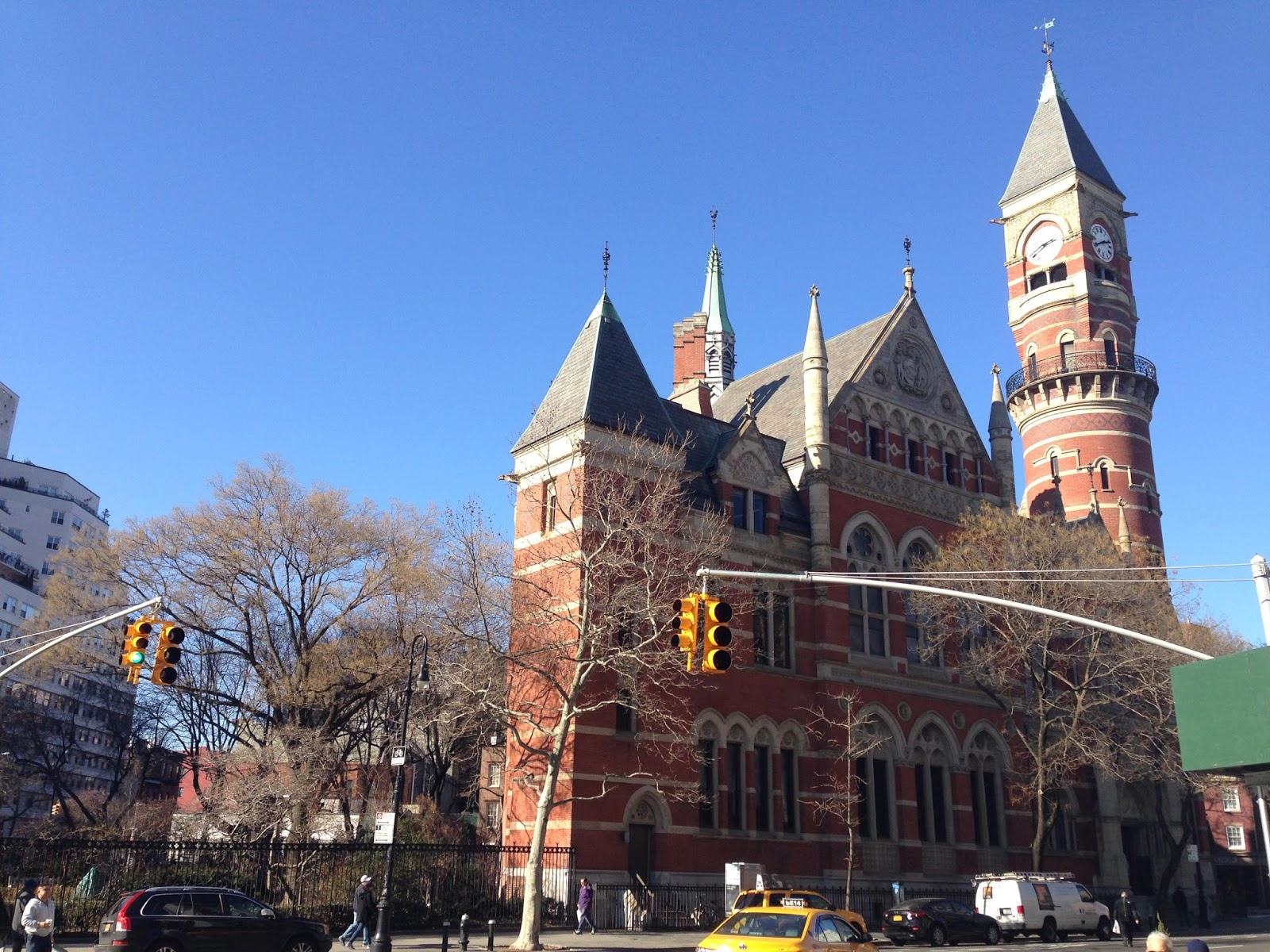
These days, the big building with the clock tower is the Jefferson Market branch of the public library, and the plot next to it is the Jefferson Market Garden. But this was not always the case. Oh no, my friend.
Jefferson Market actually used to be a market, starting in 1833. Which Jefferson was it named after? Don't overthink it... it was Thomas Jefferson. At the time there was also a firehouse, jail, and police court on that block.
The building that is now the library was originally a courthouse. It was built in 1877, as was the Jefferson Market Prison, which replaced the original jail.
The courthouse/library is a very beautiful and unique building, with many small and interesting details. Its style is called American Gothic.
In the above photo, there's something about those three rows of brick "steps" that I find interesting, plus the really small window above it.
They didn't have to throw that little owl in there, but they did, and it's adorable.
I don't know who the man inside the circle is, but this whole corner piece is really nice.
Here's the building entrance:
Above the Jefferson Market Branch sign, it still says on the building, "Third Judicial District Court-House":
Here are some views from across 6th Avenue:
Here is an illustration from the Historic American Buildings Survey of what the area looked like around 1880:
 The illustrator of the above image didn't throw in an elevated train down 6th Avenue just for some science-fiction fun; there did in fact used to be an el train there. More on that shortly.
The firehouse, jail, and market were all torn down in 1927 and replaced in 1931 with the 11-story Women's House of Detention, the only one in the city and the only jail ever built in the Art Deco style. When I was checking out the area, I met a man who knew a lot of the block's history, and he told me that in fact the women's jail was such a nice building that it actually raised property values in the area.
He also showed me a spot on the library building where the bricks are a different color, indicating the place where the courthouse and jail used to connect. You can see it straight ahead at the bottom of the building in this photo:
I used to think that the library building was a former church, because of its style and structure and also its stained glass windows. Here is a look just inside the building's entrance:
A spiral staircase leads to the 2nd floor, with beautiful windows along the way:
There are taller windows and a domed ceiling as you reach the second floor of the library:
I wasn't fully sure that it was okay to be taking photos inside the building, but it is a public library after all, so I'm hoping no one minds. I took one more picture inside a big reading room on the second floor, as secretly as possible, just in case:
Please don't be mad at me, public library. I'm a big fan. Everyone please support the NYPL!
The illustrator of the above image didn't throw in an elevated train down 6th Avenue just for some science-fiction fun; there did in fact used to be an el train there. More on that shortly.
The firehouse, jail, and market were all torn down in 1927 and replaced in 1931 with the 11-story Women's House of Detention, the only one in the city and the only jail ever built in the Art Deco style. When I was checking out the area, I met a man who knew a lot of the block's history, and he told me that in fact the women's jail was such a nice building that it actually raised property values in the area.
He also showed me a spot on the library building where the bricks are a different color, indicating the place where the courthouse and jail used to connect. You can see it straight ahead at the bottom of the building in this photo:
I used to think that the library building was a former church, because of its style and structure and also its stained glass windows. Here is a look just inside the building's entrance:
A spiral staircase leads to the 2nd floor, with beautiful windows along the way:
There are taller windows and a domed ceiling as you reach the second floor of the library:
I wasn't fully sure that it was okay to be taking photos inside the building, but it is a public library after all, so I'm hoping no one minds. I took one more picture inside a big reading room on the second floor, as secretly as possible, just in case:
Please don't be mad at me, public library. I'm a big fan. Everyone please support the NYPL!
Check out this photo below that was taken in 1935, and my attempt to show the same view in the present day:
 (Photo by Berenice Abbott)
In the 1935 photo, I'm assuming that the hint of a big building to the left of the courthouse is the 11-story Women's House of Detention.
That photo is also a good look at the 6th Avenue elevated train, which started in 1878 and ran from the southernmost parts of Manhattan in the financial district up to 58th street just south of Central Park. Above and below those areas, the line merged with the elevated Ninth Avenue train.
The photo with the el train gives me mixed emotions: on the one hand, it would be kind of cool and old-fashioned to still have an el train in lower Manhattan. On the other hand, the noise levels today often drive me crazy even without an elevated train added to the mix.
And in fact the noise and commotion caused by the el were part of the reason for it being closed in 1938 and torn down the next year. Maybe it's for the best that lower Manhattan only has below-ground trains these days.
The historian friend that I met gave me an interesting note to look into about the demolition of the el train: it turns out there were accusations that the metal materials from the demolished el were sold to the Japanese and then used to make some of their weapons in World War II. Despite official denials of this, the idea continued even several years after the war. E.E. Cummings even mentioned this idea in a poem called "plato told him," where he wrote of "a nipponized bit of/the old sixth/avenue/el..."
E.E. Cummings lived on the West 10th Street side of the Jefferson Market block, in an alley called Patchin Place. Several other writers have also lived there, along with Marlon Brando. Here's a look at Patchin Place and then West 10th Street:
The courthouse went into disuse in 1945 due to changes in the court system. The building was going to be razed in the late 1950's but was saved thanks to efforts by members of the community. In 1962 Mayor Robert F. Wagner, Jr. assented to make the building a library branch.
In 1973 the Women's House of Detention was torn down, largely due to complaints in the area about noise and disturbances. Friends and relatives of prisoners would stand outside of the building and yell to them, whether saying hello or relaying the goings-on. Other people would also gather in the area to observe all this happening. I can see how that would be a nuisance to people living nearby. Imagine if the el train was still around then too.
There were also issues of the House of Detention being overcrowded, and my historian friend said that at the top of the building was a hospital where doctors were doing bad things to people. He didn't specify but that sounded scary.
He also told me that in the Jefferson Market Garden today there are still sometimes found keys and other materials that date back to the jail.
Next to the Jefferson Market block, at the intersection of Sixth Avenue, Greenwich Avenue, and Christopher Street, is a small island of sidewalk called Ruth E. Wittenberg Triangle.
Ruth E. Wittenberg's 1990 obituary in The New York Times says she was an important person in preventing the courthouse from being torn down. She was also involved in the women's suffrage movement, which she went to jail twice for, and the civil rights movement, including participating in the Selma, Alabama march in 1965.
Across the street on 6th Avenue is C.O. Bigelow, which goes back to 1838 and says it is the oldest apothecary in the country. I like the faded advertisement on the building's wall:
According to its website, many famous people have been customers there throughout the years, including Thomas Edison, Eleanor Roosevelt, and Elvis Costello. I wonder how many times those 3 names have appeared in the same sentence.
To the right of C.O. Bigelow is LifeThyme, a really good store with natural foods and products.
It has two floors but overall a smaller, more local feel than Whole Foods.
I think that's it for this post. I don't know how well-known this block is in tourist circles, but I definitely think it's an historical highlight of lower Manhattan. Check it out if you're in the area.