Inside an unassuming, industrial-looking building on the Lower East Side is an experiment in indoor gardening that could lead to the first underground park in the world.
The Lowline Lab is on Essex Street between Rivington and Stanton and is a temporary exhibition that previews plans for a nearby subterranean park called the Lowline.
The Lowline would use solar instruments to harness and concentrate sunlight from above, then reflect it down into the park to feed the plants.
This type of botany is still in its experimental stage and part of the Lowline Lab shows the various plants and growing methods that are being tried and tinkered with. This includes a large central area with a lot of plants being grown together in soil and underneath lights that provide the solar energy, and some that provide complementary artificial light.
The total growing area is 1,000 square feet and has more than 3,000 plants. This includes several dozen different varieties, many of which are labeled. One plant was called Mother-in-Law's Tongue and was apparently named by an old-fashioned Catskills comedian.
Small envelope packets scattered throughout the plant area were labelled as containing insects that are naturally beneficial to the ecosystem. This eliminates the need for harmful pesticides. It wasn't indicated which insects were inside, and a staff member also didn't have that information. There did not seem to be much room for the insects to get out of the packets, but the staff member said that these packets actually contain the insect eggs and when they hatch they will crawl out and start doing their beneficial work.
The staff member also pointed out the fans that had been stationed around the plants to provide air flow and prevent root rot. She said that this had not been thought of originally, but after the process started it was realized that this was an important factor they were missing by growing plants indoors.
There were smaller plant displays along the perimeter of the room, including one on air plants. These are grown without soil and don't need much water. They even prefer indirect but bright light, which all sounds ideal for having in an apartment. The only possible downside is that they look like alien plants.
Another display was the worm bin, where the worms were changing food waste into plant compost. Worms are slimy, sure, but they're also great for nature and the environment.
There was a second display where plants were being grown without soil, this one labelled aeroponics. Leafy plants were growing in an enclosed space where they were being fed light and sprayed with a nutrient solution. The plant labels in there included parsley, sage, and Buttercrunch lettuce.
One of the big boards in the first room of the exhibit explained the importance of natural sunlight since it provides a fuller spectrum of light that is needed for plants (and humans) to grow and function in good health. There were also graphics that showed how the technology works, which involves mirrors capturing the sunlight and then this light being concentrated and having the hot infrared rays filtered out before being delivered inside to the plants.
In the plant-growing room there was another sign explaining how a red tint was caused by an infrared lens filtering out the UV and infrared rays.
Extra lights have been installed to find the right balance for growing the plants indoors. There were hexagonal lights above the plants that provided occasional red light. Although the red light spectrum had been filtered out, some red light is needed for the flowering and fruiting of plants to occur.
Other lights were being used to help find the best balance for growing the plants at optimal health.
The Lowline Lab opened in October 2015 and will close later this month, on February 26. It is open to the public on weekend afternoons. Even though the Lab is actually at street level, it simulates the same projected conditions that the underground Lowline park would have.
The actual Lowline has a planned opening date of 2021 and will be a block south from the Lab, in an abandoned trolley terminal that is across from a current Essex Street station for the J train at Delancey Street. The trolley terminal was built in 1908 and was used as part of the trolley service that went across the new Williamsburg Bridge. The trolley service was halted in 1948, and the terminal has been sitting there in disuse ever since.
The space still has old cobblestones and rail tracks in it, which would add to what could be a very interesting underground space that would combine old elements with new forms of gardening. The old rail tracks would also give the Lowline something else in common with the High Line other than having its name derived from it, since there are tracks along the High Line as well from old routes for freight trains.
The Lowline project has received a lot of public and private financial support. A 2012 Kickstarter campaign for an exhibit called "Imagining the Lowline" raised over $155,000 from 3,300 people, and a 2015 Kickstarter fund for the Lowline Lab generated over $223,000 from over 2,500 people.
The Lowline also has sponsorships from a number of corporations and support from many community businesses, organizations and local politicians including Senators Charles Schumer and Kirsten Gillibrand.
The Lab is free to visitors but they accept donations and there is also a makeshift gift shop they have set up, with all the money going to the Lowline project.
If successful, the Lowline could be a pioneer in underground parks and in a type of urban gardening that may bring more plants and local food sources to cities. This is especially important since an increasing percentage of the world's population live in urban areas. According to the United Nations, over half of the world's people live in cities and that number is expected to grow to two-thirds by 2050.
The impact that underground parks and gardening will have remains to be seen. At the very least, however, the Lowline Lab is a good way to learn some important science and experience nature while also staying warm on a frigid winter day in New York.
A blog for locals and tourists that explores different parts of Manhattan, including current events, food, street art, parks, and more.
Showing posts with label New York City. Show all posts
Tuesday, February 14, 2017
Thursday, October 27, 2016
Arts and Nonprofits: West Houston Street between 6th Avenue and Varick
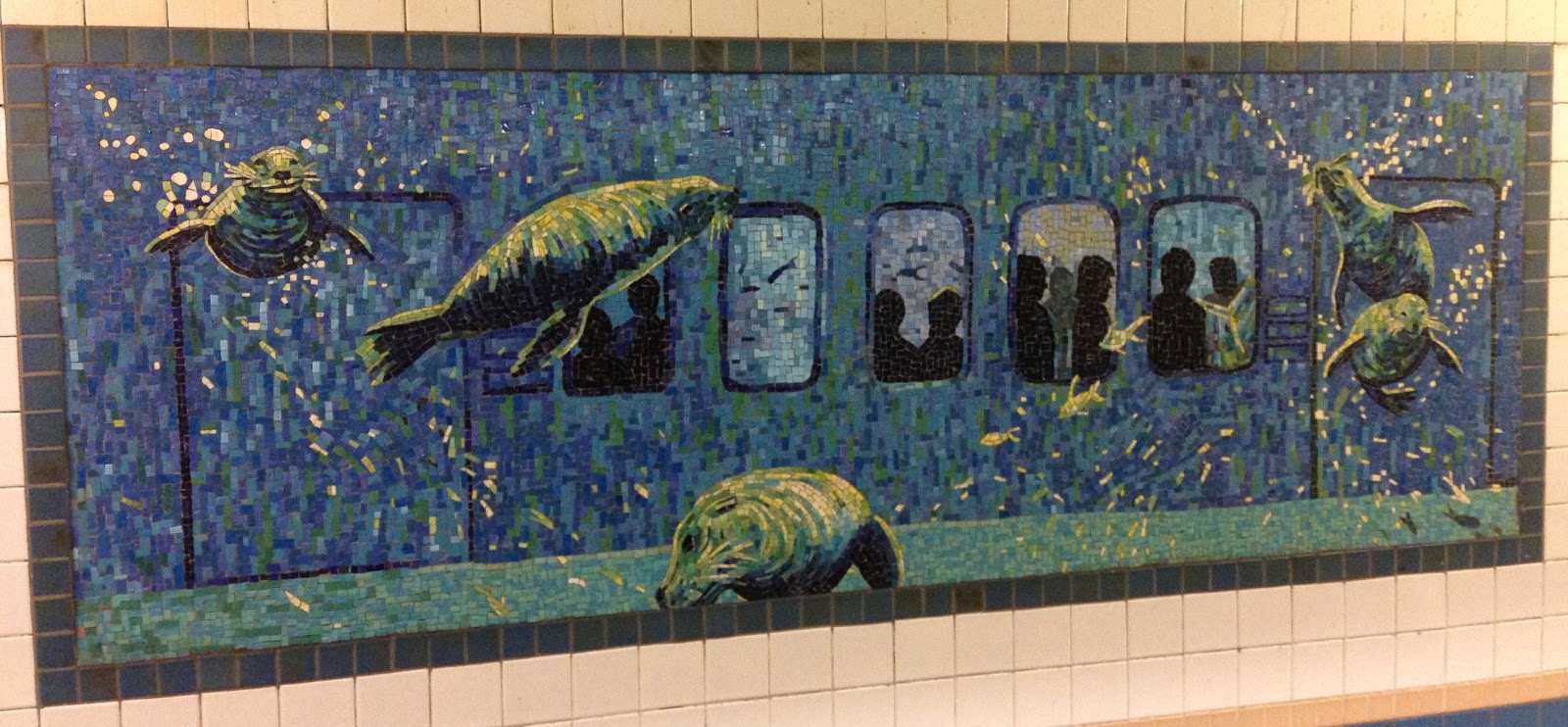
On this block we'll start underground at the Houston Street subway station because it has some great mosaic art, seven pieces in all by Deborah Brown.
The top one is called "Family Outing," and the other is "Straphangers."
The overall project is called "Platform Diving" and is from 1994 as part of renovations that were made to the station.
This is my local stop on the 1 train but I had never noticed all of these mosaics in the station. Seriously, what is my problem? Well, at least I'm finally appreciating them now.
The overall concept is a playful parallel between underwater marine life and the underground subway world of the city. It's a good idea and I like the surreal element to the images.
Here are "Eye-opener," then "Turtles Ride for Free," and then "Night Shift":
And lastly here's "Morning Rush," followed by "Diving Platform" which I took in 2 photos because people were sitting in the seats in front of it so I tried to shoot around them.
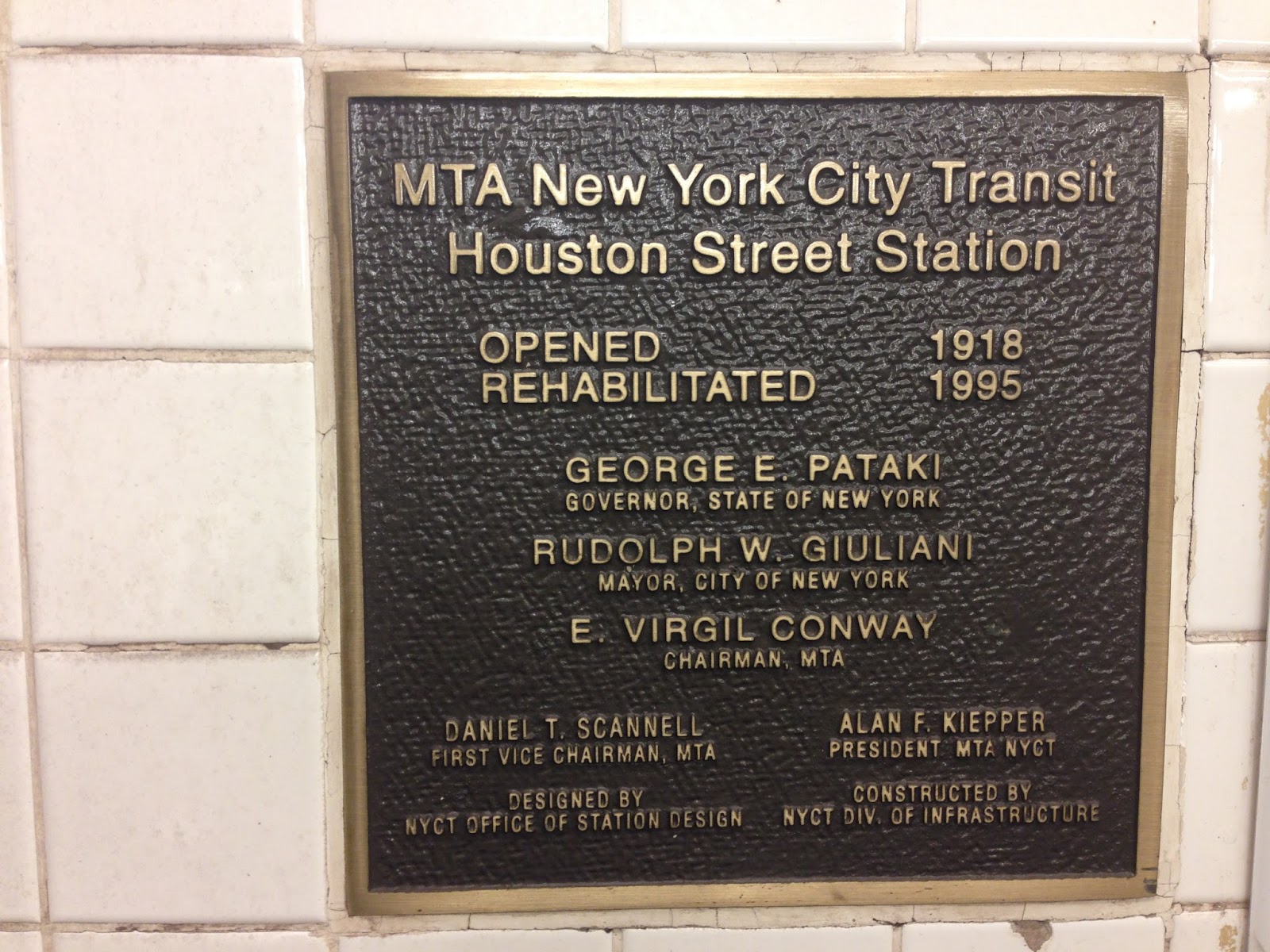
There is a plaque showing that this station dates back all the way to 1918.
Along with the marine life, there are other cool mosaic tile works in the station that go back to its origins and the designer Squire Vickers, who was behind much of the city's subway station designs.
Try to ignore the jarring Tyler Perry Halloween poster.
Anyway the older tile work on the station names and upper borders is nothing too elaborate but provides a nice touch. It was done in the Arts and Crafts style, which was an art movement in the late 1800's and early 1900's that was generally anti-industrialist and emphasized more natural and authentic craftsmanship.
I also like the lower border of tiling though that looks much newer and was perhaps part of the 1990's renovation.
Above ground, the Film Forum is a cultural landmark of the city. It started in 1970 and has been at this location since 1989. It is an art-house theater that shows new and old films, and according to its website "is the only autonomous nonprofit cinema in New York City and one of the few in the U.S."
Its marquee is a more prominent presence on the block when the scaffolding isn't there. It's to the right in this first photo:
There was a cool poster outside the theater for upcoming family films they show on Sunday mornings:
And here's a brief peak inside the lobby:
On the wall just inside the lobby entrance is an illustration by Al Hirschfeld:
Hirschfeld would often hide his daughter's name Nina in his works, and it appears in this one just to the right of Hitchcock:
Also on the block is Gilda's Club New York City, a nonprofit which gives free cancer support and resources to patients and families, combining with partners to reach over 20,000 people every year.
It was started in 1995 and named after comedian Gilda Radner, who died in 1989 of ovarian cancer. Among the founders was Gene Wilder, who was Radner's husband when she died.
Gilda's Club Worldwide was started in 2000 and combined with The Wellness Community to become the Cancer Support Community, which is currently the biggest support network for cancer in the nation.
In 2005, which was the 10th anniversary of Gilda's Club NYC, a street sign marking Gilda Radner Way was dedicated near the 6th Avenue corner.
In the above photo is a hint of the small park just next to the sign.
Even though the park is next to a big intersection and a particularly noisy stretch of Houston Street that leads to the Holland Tunnel and West Side Highway, it is still a nice little area with benches and greenery, even in late October.
There are 2 other nonprofit organizations on the block: VillageCare Rehabilitation and Nursing Center and a location of AHRC NYC, which helps people with intellectual and developmental disabilities.
Then there is a shop that buys and sells antique firearms and Americana, which seems a bit random to be on this block but hey why not.
And lastly there is a stretch near the corner at Varick with bars and food, including a Subway 'restaurant,' plus a psychic.
It's an interesting block and more eclectic than I realized. Hope you enjoyed this look at it, and thanks for reading.
The top one is called "Family Outing," and the other is "Straphangers."
The overall project is called "Platform Diving" and is from 1994 as part of renovations that were made to the station.
This is my local stop on the 1 train but I had never noticed all of these mosaics in the station. Seriously, what is my problem? Well, at least I'm finally appreciating them now.
The overall concept is a playful parallel between underwater marine life and the underground subway world of the city. It's a good idea and I like the surreal element to the images.
Here are "Eye-opener," then "Turtles Ride for Free," and then "Night Shift":
And lastly here's "Morning Rush," followed by "Diving Platform" which I took in 2 photos because people were sitting in the seats in front of it so I tried to shoot around them.
There is a plaque showing that this station dates back all the way to 1918.
Along with the marine life, there are other cool mosaic tile works in the station that go back to its origins and the designer Squire Vickers, who was behind much of the city's subway station designs.
Anyway the older tile work on the station names and upper borders is nothing too elaborate but provides a nice touch. It was done in the Arts and Crafts style, which was an art movement in the late 1800's and early 1900's that was generally anti-industrialist and emphasized more natural and authentic craftsmanship.
I also like the lower border of tiling though that looks much newer and was perhaps part of the 1990's renovation.
Above ground, the Film Forum is a cultural landmark of the city. It started in 1970 and has been at this location since 1989. It is an art-house theater that shows new and old films, and according to its website "is the only autonomous nonprofit cinema in New York City and one of the few in the U.S."
Its marquee is a more prominent presence on the block when the scaffolding isn't there. It's to the right in this first photo:
There was a cool poster outside the theater for upcoming family films they show on Sunday mornings:
And here's a brief peak inside the lobby:
On the wall just inside the lobby entrance is an illustration by Al Hirschfeld:
Hirschfeld would often hide his daughter's name Nina in his works, and it appears in this one just to the right of Hitchcock:
It was started in 1995 and named after comedian Gilda Radner, who died in 1989 of ovarian cancer. Among the founders was Gene Wilder, who was Radner's husband when she died.
Gilda's Club Worldwide was started in 2000 and combined with The Wellness Community to become the Cancer Support Community, which is currently the biggest support network for cancer in the nation.
In 2005, which was the 10th anniversary of Gilda's Club NYC, a street sign marking Gilda Radner Way was dedicated near the 6th Avenue corner.
In the above photo is a hint of the small park just next to the sign.
Even though the park is next to a big intersection and a particularly noisy stretch of Houston Street that leads to the Holland Tunnel and West Side Highway, it is still a nice little area with benches and greenery, even in late October.
There are 2 other nonprofit organizations on the block: VillageCare Rehabilitation and Nursing Center and a location of AHRC NYC, which helps people with intellectual and developmental disabilities.
Then there is a shop that buys and sells antique firearms and Americana, which seems a bit random to be on this block but hey why not.
And lastly there is a stretch near the corner at Varick with bars and food, including a Subway 'restaurant,' plus a psychic.
It's an interesting block and more eclectic than I realized. Hope you enjoyed this look at it, and thanks for reading.
Subscribe to:
Posts (Atom)