Showing posts with label downtown. Show all posts

Tuesday, February 14, 2017

The Lowline Lab

Inside an unassuming, industrial-looking building on the Lower East Side is an experiment in indoor gardening that could lead to the first underground park in the world. 

The Lowline Lab is on Essex Street between Rivington and Stanton and is a temporary exhibition that previews plans for a nearby subterranean park called the Lowline.

The Lowline would use solar instruments to harness and concentrate sunlight from above, then reflect it down into the park to feed the plants. 

This type of botany is still in its experimental stage and part of the Lowline Lab shows the various plants and growing methods that are being tried and tinkered with. This includes a large central area with a lot of plants being grown together in soil and underneath lights that provide the solar energy, and some that provide complementary artificial light. 


The total growing area is 1,000 square feet and has more than 3,000 plants. This includes several dozen different varieties, many of which are labeled. One plant was called Mother-in-Law's Tongue and was apparently named by an old-fashioned Catskills comedian. 


Small envelope packets scattered throughout the plant area were labelled as containing insects that are naturally beneficial to the ecosystem. This eliminates the need for harmful pesticides. It wasn't indicated which insects were inside, and a staff member also didn't have that information. There did not seem to be much room for the insects to get out of the packets, but the staff member said that these packets actually contain the insect eggs and when they hatch they will crawl out and start doing their beneficial work.

The staff member also pointed out the fans that had been stationed around the plants to provide air flow and prevent root rot. She said that this had not been thought of originally, but after the process started it was realized that this was an important factor they were missing by growing plants indoors.

There were smaller plant displays along the perimeter of the room, including one on air plants. These are grown without soil and don't need much water. They even prefer indirect but bright light, which all sounds ideal for having in an apartment. The only possible downside is that they look like alien plants.

Another display was the worm bin, where the worms were changing food waste into plant compost. Worms are slimy, sure, but they're also great for nature and the environment.


There was a second display where plants were being grown without soil, this one labelled aeroponics. Leafy plants were growing in an enclosed space where they were being fed light and sprayed with a nutrient solution. The plant labels in there included parsley, sage, and Buttercrunch lettuce. 


One of the big boards in the first room of the exhibit explained the importance of natural sunlight since it provides a fuller spectrum of light that is needed for plants (and humans) to grow and function in good health. There were also graphics that showed how the technology works, which involves mirrors capturing the sunlight and then this light being concentrated and having the hot infrared rays filtered out before being delivered inside to the plants. 


In the plant-growing room there was another sign explaining how a red tint was caused by an infrared lens filtering out the UV and infrared rays.   

Extra lights have been installed to find the right balance for growing the plants indoors. There were hexagonal lights above the plants that provided occasional red light. Although the red light spectrum had been filtered out, some red light is needed for the flowering and fruiting of plants to occur. 

Other lights were being used to help find the best balance for growing the plants at optimal health. 


The Lowline Lab opened in October 2015 and will close later this month, on February 26. It is open to the public on weekend afternoons. Even though the Lab is actually at street level, it simulates the same projected conditions that the underground Lowline park would have. 

The actual Lowline has a planned opening date of 2021 and will be a block south from the Lab, in an abandoned trolley terminal that is across from a current Essex Street station for the J train at Delancey Street. The trolley terminal was built in 1908 and was used as part of the trolley service that went across the new Williamsburg Bridge. The trolley service was halted in 1948, and the terminal has been sitting there in disuse ever since. 

The space still has old cobblestones and rail tracks in it, which would add to what could be a very interesting underground space that would combine old elements with new forms of gardening. The old rail tracks would also give the Lowline something else in common with the High Line other than having its name derived from it, since there are tracks along the High Line as well from old routes for freight trains.  

The Lowline project has received a lot of public and private financial support. A 2012 Kickstarter campaign for an exhibit called "Imagining the Lowline" raised over $155,000 from 3,300 people, and a 2015 Kickstarter fund for the Lowline Lab generated over $223,000 from over 2,500 people. 

The Lowline also has sponsorships from a number of corporations and support from many community businesses, organizations and local politicians including Senators Charles Schumer and Kirsten Gillibrand.  

The Lab is free to visitors but they accept donations and there is also a makeshift gift shop they have set up, with all the money going to the Lowline project. 

If successful, the Lowline could be a pioneer in underground parks and in a type of urban gardening that may bring more plants and local food sources to cities. This is especially important since an increasing percentage of the world's population live in urban areas. According to the United Nations, over half of the world's people live in cities and that number is expected to grow to two-thirds by 2050.


The impact that underground parks and gardening will have remains to be seen. At the very least, however, the Lowline Lab is a good way to learn some important science and experience nature while also staying warm on a frigid winter day in New York. 

Wednesday, November 30, 2016

Astor Place


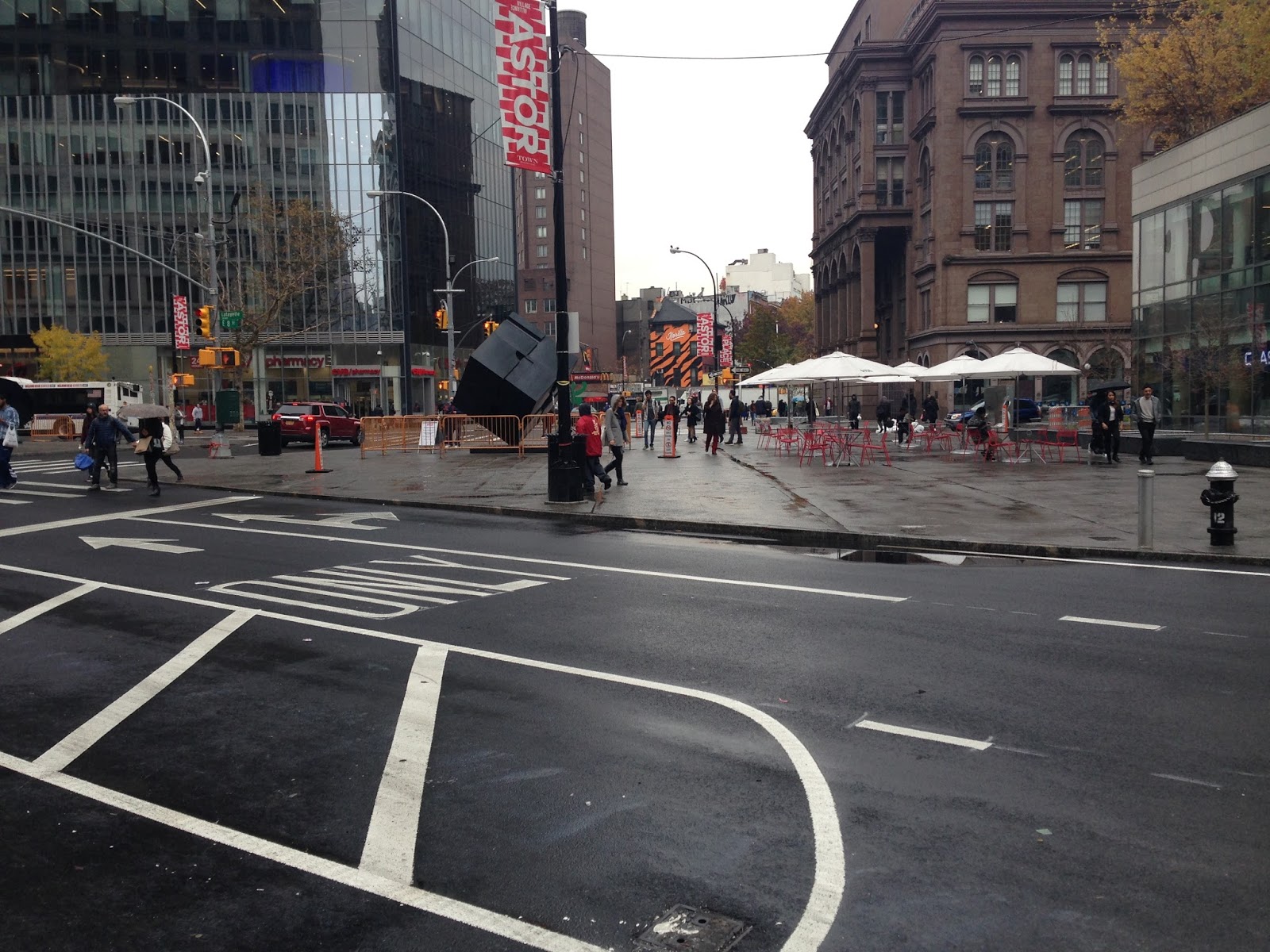
Astor Place recently underwent some renovations that created a new pedestrian area to replace one of the streets. Tables and chairs have been set up where metal auto monsters once roamed. 
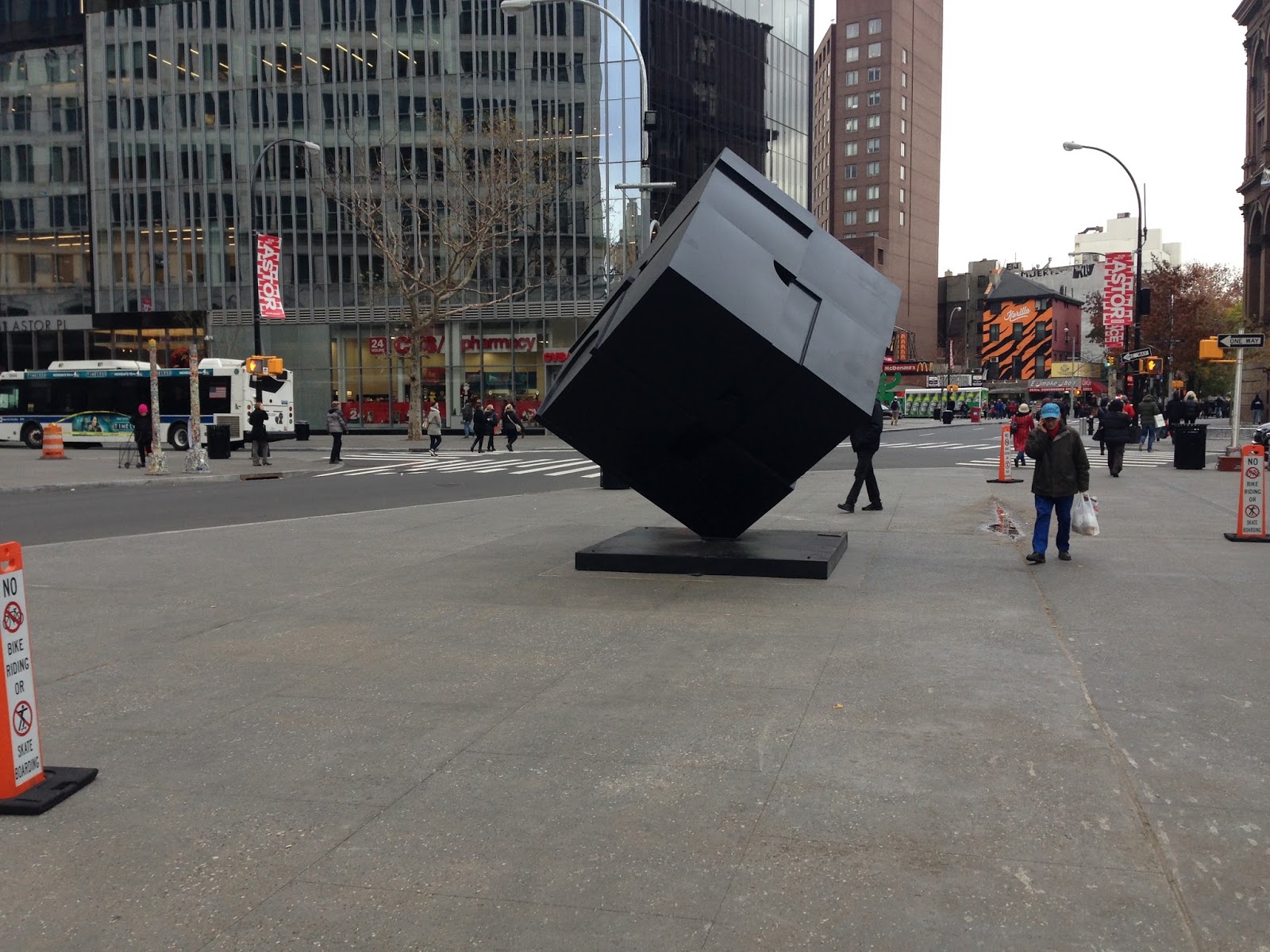
Even more exciting is the reappearance of the big cube sculpture in the same pedestrian area. 
The Cube has been an iconic presence in downtown Manhattan and Astor Place didn't feel right without it. I actually didn't know whether it would ever be returned or if The Powers That Be had decided that it had somehow run its course. But I'm glad it's back and I no long have a lost-at-sea feeling while walking through the area.

Amazingly I never knew that the Cube is actually called Alamo. It is from 1967 and by Bernard (Tony) Rosenthal. 


I've always liked that it is an interactive piece of art because it can be spun by any person or persons who have the strength and panache to just go for it. 

When I first visited on November 9 (let history note that it was a cold and rainy day) there was a sign next to Alamo reassuring people that after a little more renovation, the barricades around it would be removed and the spinning could commence.
I was back in the area on November 21 and sure enough, the gates were gone and the Cube was open to the public.
However, I saw a guy grab one of the corners and try to give it a spin, but the Cube wouldn't budge. It seemed to be welded in place to its base support. Maybe that will change eventually but it was disappointing to see.  
  
If a big cube doesn't do it for you, there is other cool art at Astor Place that has also been restored. 

I have covered some of Jim Power's mosaic work in previous posts on the East Village and here at Astor Place there are four more light posts that have the Mosaic Man's quirky, colorful, wonderful work on them, along with a big flower pot. 


These particular mosaics include tributes to the NYPD and FDNY and a big American flag. There are also tributes to many local shops and sites including the now-gone CBGB's and Billy's Antiques and Props, which unfortunately is also gone. It had to close its distinct tent location at East Houston Street in 2012 to make way for construction of a rather generic retail brick building. At least the Bowery Mural on the same block keeps that area interesting.


Fortunately it seems that Astor Place has been able to keep much of its character and personality in tact, although there was a dispute during the recent renovations over a piece of its history being potentially forgotten with the removal of the street that made way for the pedestrian plaza. 

The removed street was a section of the actual street that is called Astor Place and which ran west to east from Broadway to East 8th Street near St. Marks Place. With the new pedestrian area, there are now two strips of Astor Place on either side of the plaza but the middle part is gone. 

After the new renovation plans for the area were revealed by the city, the Greenwich Village Society for Historic Preservation (GVSHP) pointed out that Astor Place followed an old Native American trail that appeared on maps going back to 1639 and thus represented an important connection between New York City and its native and early Dutch roots.

Centuries ago the Lenape lived in this area of the country and what is now Astor Place was a meeting spot for three different groups of the Lenape: Canarsie, Sapohannikan, and Manhattan. The trail actually ran east from this meeting spot, connecting to what is now Stuyvesant Street and going all the way to modern-day Second Avenue. 

GVSHP petitioned the city to include the area's history in the new designs for Astor Place and apparently they were successful because there are a couple of distinct and marked lines in the ground running across the plaza where the middle section of the Astor Place street used to be. 

One reads "Native American Trail 1639" and another says "Astor Place 1836." Just east of the plaza there is another one marked "Stuyvesant Street 1651." Ideally there would even be a plaque or two to provide a bit more info on these topics, but anyone who is interested can always do a Google search. 


Just north of the new plaza is an old-fashioned subway entrance for the Astor Place station on the 6 train. It is actually a replica of one of the station's original kiosks from the early 20th century.

Down in the station there are many plaques with beavers on them, which I admit I had never noticed before. Even if I had noticed them, I would have just been confused at their seeming randomness.

There is, however, a good reason for the beaver plaques because John Jacob Astor (as in 'Astor Place') amassed his fortune by trading beaver pelts with the Lenape. The beaver plaques and Astor Place name tablets in the station are all beautiful and multi-colored and date back to the station's original 1904 opening.


One final item of note: a building on the western side of Astor Place with a Starbucks on the ground floor seems innocent enough (unless you hate Starbucks) but it is actually the former site of the Astor Opera House, which also sounds innocent except that is was where a major riot occurred in 1849 that killed approximately 25 people and wounded over 120.


It started in a way that we don't think of most riots starting: over a dispute between two theater actors over who could perform Shakespeare better. 

There was some more social context to it, of course. This was a time in New York with a lot of tensions between social classes, including nativists versus Irish immigrants and both of those groups against the wealthy elite. Fortunately there are no longer class issues in America having to do with nativism and elitism...

Anyway in the case of the riot, the working classes and Irish immigrants revolted against the upper classes and the British culture that the elite embraced and came to represent.

One of the actors was a celebrated British performer named William Charles Macready and his rival was Edwin Forrest, who was the first major American actor and was passionately embraced by the working classes and Irish immigrants.     

Tensions had been bubbling for years and even decades, with British actors being targets of American anger going back to the 1700's because they were a tangible way for anti-British sentiments to be expressed.

The Astor Opera House itself caused anger and resentments to come to a head because wealthy theater lovers had it built for the upper classes as a way of being separate from the working classes. Traditionally everyone had mixed in when attending the theater and so this new opera house for the wealthy was an outrage to the populists. 

(Depiction of the Astor Opera House in 1850)
 

The riot occurred on May 10, 1849, when thousands of angry people gathered outside the Astor Opera House where the British actor Macready was to perform Macbeth. The crowds had skirmishes with the police as they threw stones at the building and tried unsuccessfully to set the building on fire. 

There was such chaos inside the theater that the play had to be finished in pantomime, followed by Macready sneaking out in a disguise. 

The state militia was called upon to deal with the crowds outside the building. After the troops issued warnings that were not heard, they fired into the air and then directly into the crowds, which was the first time a state militia had ever done that. Most of those killed were from the working classes, and many were innocent bystanders. This act by the militia outraged the working classes and was praised by the elite of the city. 

Astor Opera House came to be known by some as the 'Massacre Opera House' at 'DisAster Place' and it did not survive much longer as a theater. The wealthy would build a new opera house, the Academy of Music, which was located a little more uptown and thus further away from the downtown lower classes. The current building on that spot has condominiums and the aforementioned Starbucks and was built in 1890.

After learning of the Astor Place Riot it was a bit odd and eerie to walk around in the area that I have walked through so many times without knowing that part of its history. Compared to the deadly riot it now seems like such a tranquil place. I will certainly think twice the next time I'm tempted to complain of how 'busy' or 'chaotic' the intersection is.

Thursday, October 27, 2016

Arts and Nonprofits: West Houston Street between 6th Avenue and Varick

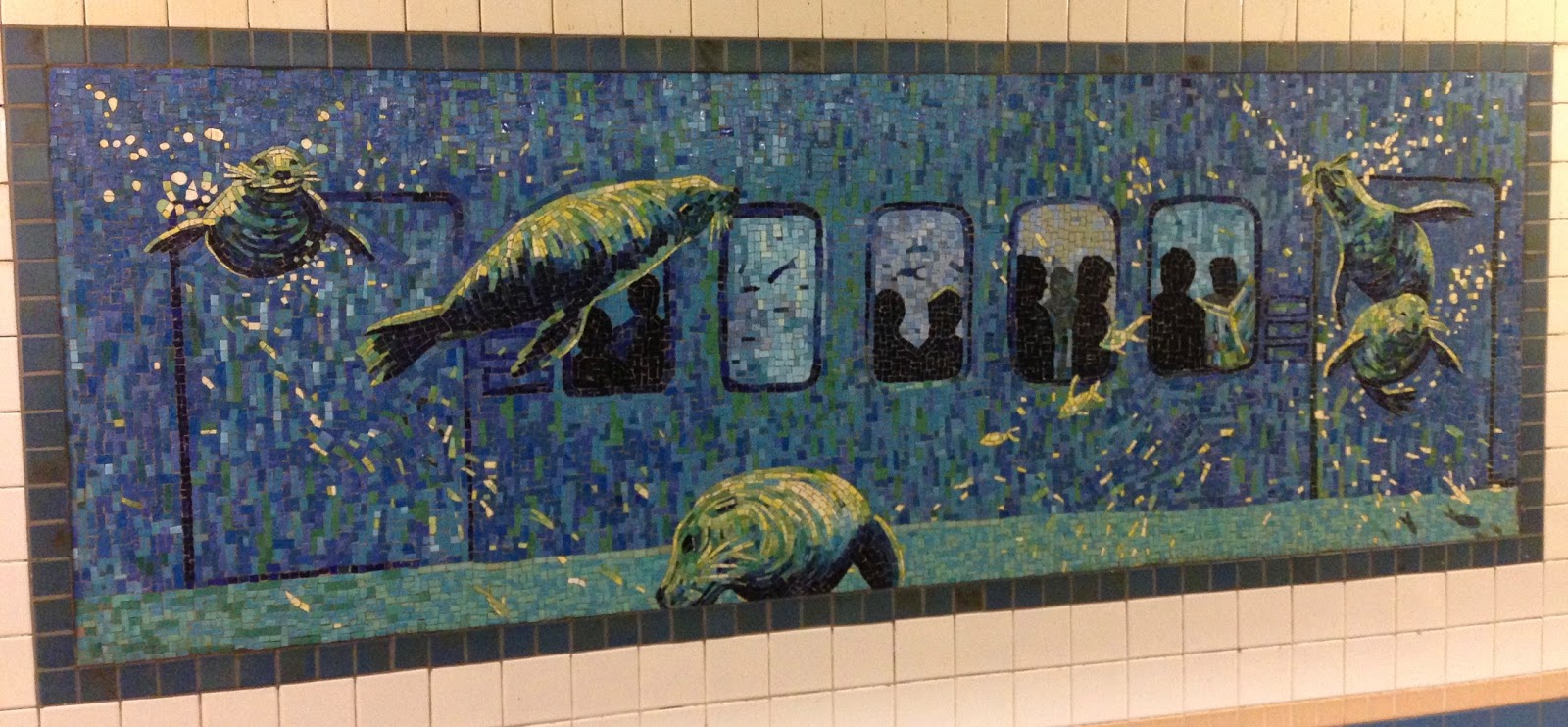
On this block we'll start underground at the Houston Street subway station because it has some great mosaic art, seven pieces in all by Deborah Brown.

The top one is called "Family Outing," and the other is "Straphangers." 

The overall project is called "Platform Diving" and is from 1994 as part of renovations that were made to the station. 
This is my local stop on the 1 train but I had never noticed all of these mosaics in the station. Seriously, what is my problem? Well, at least I'm finally appreciating them now. 

The overall concept is a playful parallel between underwater marine life and the underground subway world of the city. It's a good idea and I like the surreal element to the images.

Here are "Eye-opener," then "Turtles Ride for Free," and then "Night Shift":


And lastly here's "Morning Rush," followed by "Diving Platform" which I took in 2 photos because people were sitting in the seats in front of it so I tried to shoot around them.


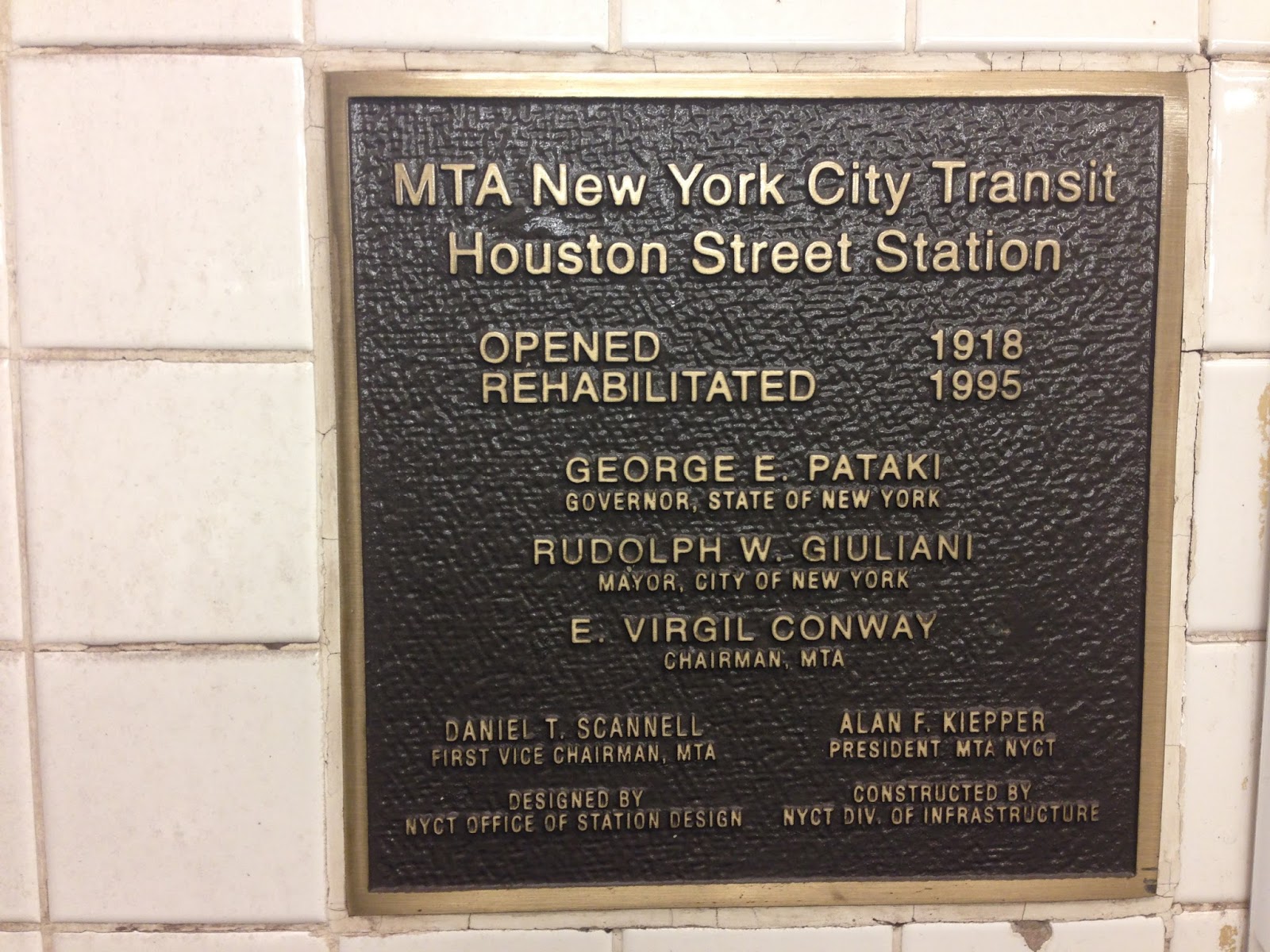
There is a plaque showing that this station dates back all the way to 1918.
Along with the marine life, there are other cool mosaic tile works in the station that go back to its origins and the designer Squire Vickers, who was behind much of the city's subway station designs.

Try to ignore the jarring Tyler Perry Halloween poster. 

Anyway the older tile work on the station names and upper borders is nothing too elaborate but provides a nice touch. It was done in the Arts and Crafts style, which was an art movement in the late 1800's and early 1900's that was generally anti-industrialist and emphasized more natural and authentic craftsmanship.

I also like the lower border of tiling though that looks much newer and was perhaps part of the 1990's renovation.   

Above ground, the Film Forum is a cultural landmark of the city. It started in 1970 and has been at this location since 1989. It is an art-house theater that shows new and old films, and according to its website "is the only autonomous nonprofit cinema in New York City and one of the few in the U.S."

Its marquee is a more prominent presence on the block when the scaffolding isn't there. It's to the right in this first photo:


There was a cool poster outside the theater for upcoming family films they show on Sunday mornings:
And here's a brief peak inside the lobby:
On the wall just inside the lobby entrance is an illustration by Al Hirschfeld:

Hirschfeld would often hide his daughter's name Nina in his works, and it appears in this one just to the right of Hitchcock:

Also on the block is Gilda's Club New York City, a nonprofit which gives free cancer support and resources to patients and families, combining with partners to reach over 20,000 people every year. 
It was started in 1995 and named after comedian Gilda Radner, who died in 1989 of ovarian cancer. Among the founders was Gene Wilder, who was Radner's husband when she died. 

Gilda's Club Worldwide was started in 2000 and combined with The Wellness Community to become the Cancer Support Community, which is currently the biggest support network for cancer in the nation. 

In 2005, which was the 10th anniversary of Gilda's Club NYC, a street sign marking Gilda Radner Way was dedicated near the 6th Avenue corner. 
In the above photo is a hint of the small park just next to the sign.
Even though the park is next to a big intersection and a particularly noisy stretch of Houston Street that leads to the Holland Tunnel and West Side Highway, it is still a nice little area with benches and greenery, even in late October.


There are 2 other nonprofit organizations on the block: VillageCare Rehabilitation and Nursing Center and a location of AHRC NYC, which helps people with intellectual and developmental disabilities. 

Then there is a shop that buys and sells antique firearms and Americana, which seems a bit random to be on this block but hey why not.
And lastly there is a stretch near the corner at Varick with bars and food, including a Subway 'restaurant,' plus a psychic. 


It's an interesting block and more eclectic than I realized. Hope you enjoyed this look at it, and thanks for reading.