While Christopher Street is an iconic part of the West Village and the corner of Christopher and 7th Avenue has the historic mainstay Village Cigars, there is another smaller piece of history at that corner that is quite interesting.
On the sidewalk just in front of the entrance to Village Cigars is a curious tile mosaic.
It is cracked and a bit worn but can still mostly be read: "Property of the Hess estate which has never been dedicated for public purposes."
According to The Villager, in the 1910's New York City, as part of its process of expanding 7th Avenue and a subway line, used eminent domain to claim many buildings in the area. The city paid for the properties and then demolished hundreds of buildings.
This included a Hess estate building called the Voorhis, which was 5 stories tall and once owned by Philadelphia man David M. Hess.
Amazingly, after the city had finished its project, the Hess estate realized that this small triangle had not been claimed by the city and still belonged to them.
The city asked the estate to donate it to them, because of course the city would have the nerve to ask something like that... plus what was the estate going to do with it?
Well, they fought to keep the triangle and then, according to RoadsideAmerica.com, had this tile mosaic installed on July 27, 1922.
Somehow the spiteful symbol is still there 94 years later. Ah, the power of spite.
It probably deserves a plaque at the spot explaining the incredible story. Though I guess the city wouldn't want to put up a plaque about an estate sticking it to them even through a small gesture. After all the mosaic is really just a fancy way of saying 'Screw you.'
By the way, the triangle was believed to be the smallest piece of property in the city and was sold to Village Cigars in 1938 for $1,000.
Here's another photo of the triangle, because I found it fun to read again after knowing the story behind it:
It's hard to top a story like that but it's also pretty amazing that Village Cigars has been at this corner since the earlier part of the 20th century.
The billboard above it changes, but the storefront always seems to remain the same. It was even used in 'Friends' episodes as establishing shots to let viewers know that the characters were in Greenwich Village.
The Christopher Street block itself has nice old-fashioned buildings and lots of trees.
It's a pleasant and pretty quiet street once you get away from the 7th Avenue intersection. Though it is between that avenue and Bleecker Street on the other side, so nights and especially weekends can be much louder and crazier.
Anyway there are other stores near 7th Avenue including a pharmacy, a money transferring shop, and a local artisanal place called Dunkin' Donuts.
Next to DD is Fat Cat, which is a fun place for Ping-Pong, pool, and especially table shuffleboard, which is a very underrated game.
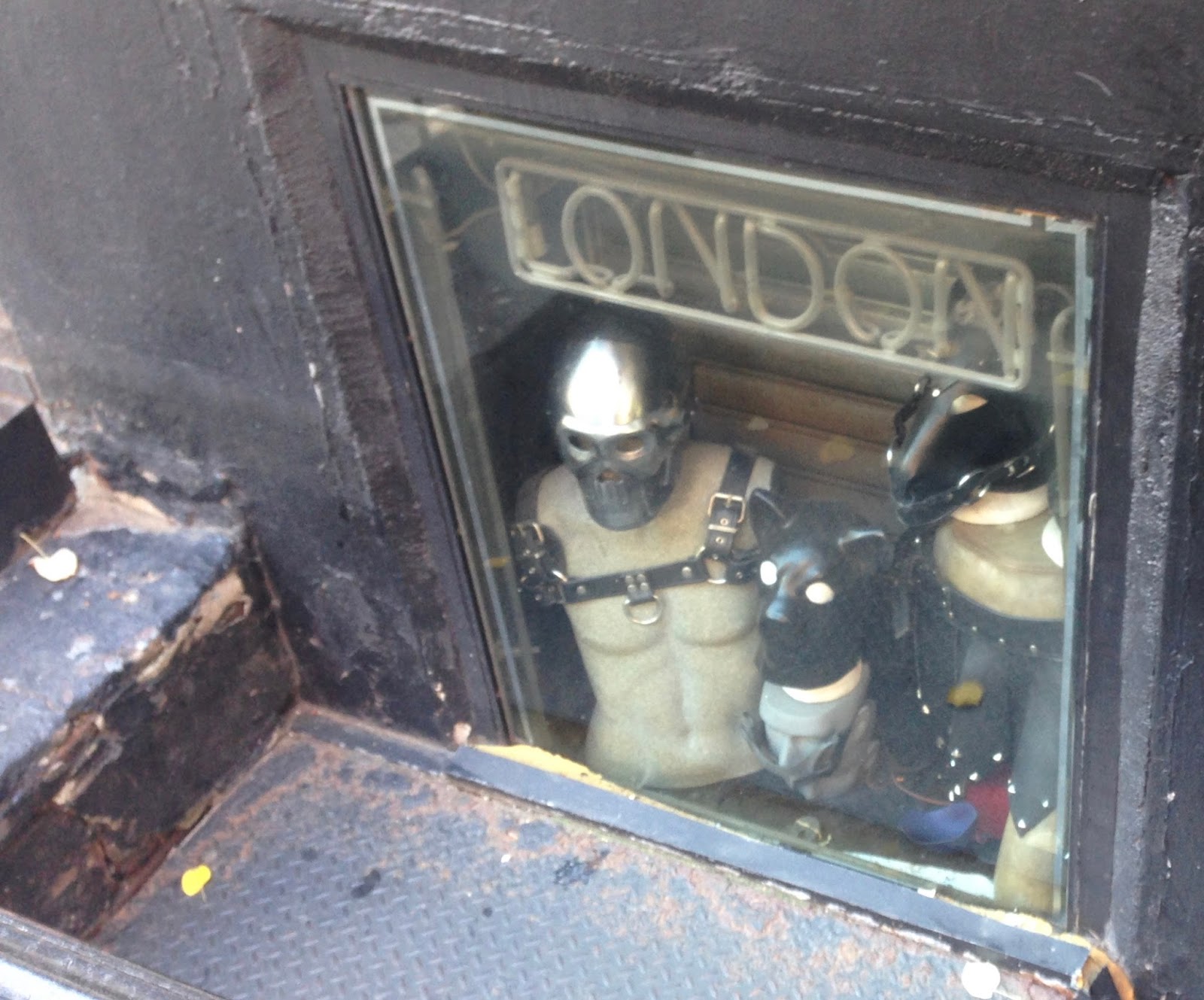
Further up the block I saw a store sign that read London.
Based on the name I thought it might be a trendy or avant-garde clothing store. Then I saw the window display below street level.
Um... maybe it's really really avant-garde? Is this the latest fashion? I'm not up on things.
Actually according to Google Maps it's called London Fetish and is an 'adult entertainment store.' It was closed, which perhaps is not surprising because I was there in the mid-morning and it didn't seem like the kind of shop that would get a lot of customers during that time.
Even though it's called London Fetish, the sign just says London, which I think is somewhat unfair to that city. If I was in London and saw a sex shop with a sign that just said New York, I might take offense. But I digress.
Across the street is, well, a church, which emphasizes the general diversity and tolerance of this area.
It's a nice building and goes back to the early 19th century.
There were two benches just outside, including an adorable little one, perhaps for children.
Are you wondering if there's a Scandinavian candy store on the block? There is and it's called Sockerbit:
Perhaps a Scandinavian shop isn't as random as I first thought, because next to the St. John's Lutheran Church is the Finnish Lutheran Church, which I didn't realize when I was on the block. They have a website and from what I can tell it is still in use, though much of the site is in Finnish (I assume).
At the Bleecker Street corner is a women's clothing shop called Accessorize. It didn't seem 'avant-garde' in any way.
Here's a look back from the Bleecker Street area:
I think that's all for this post. Here are some final looks near 7th Avenue.
From now on when I walk by Village Cigars I'll be sure to look down at the Hess triangle and appreciate the history behind it.
Thanks for reading.
The two sides of this street are practically on different blocks, since they are separated by the very wide Houston Street.
Death, taxes, and construction on Houston Street.
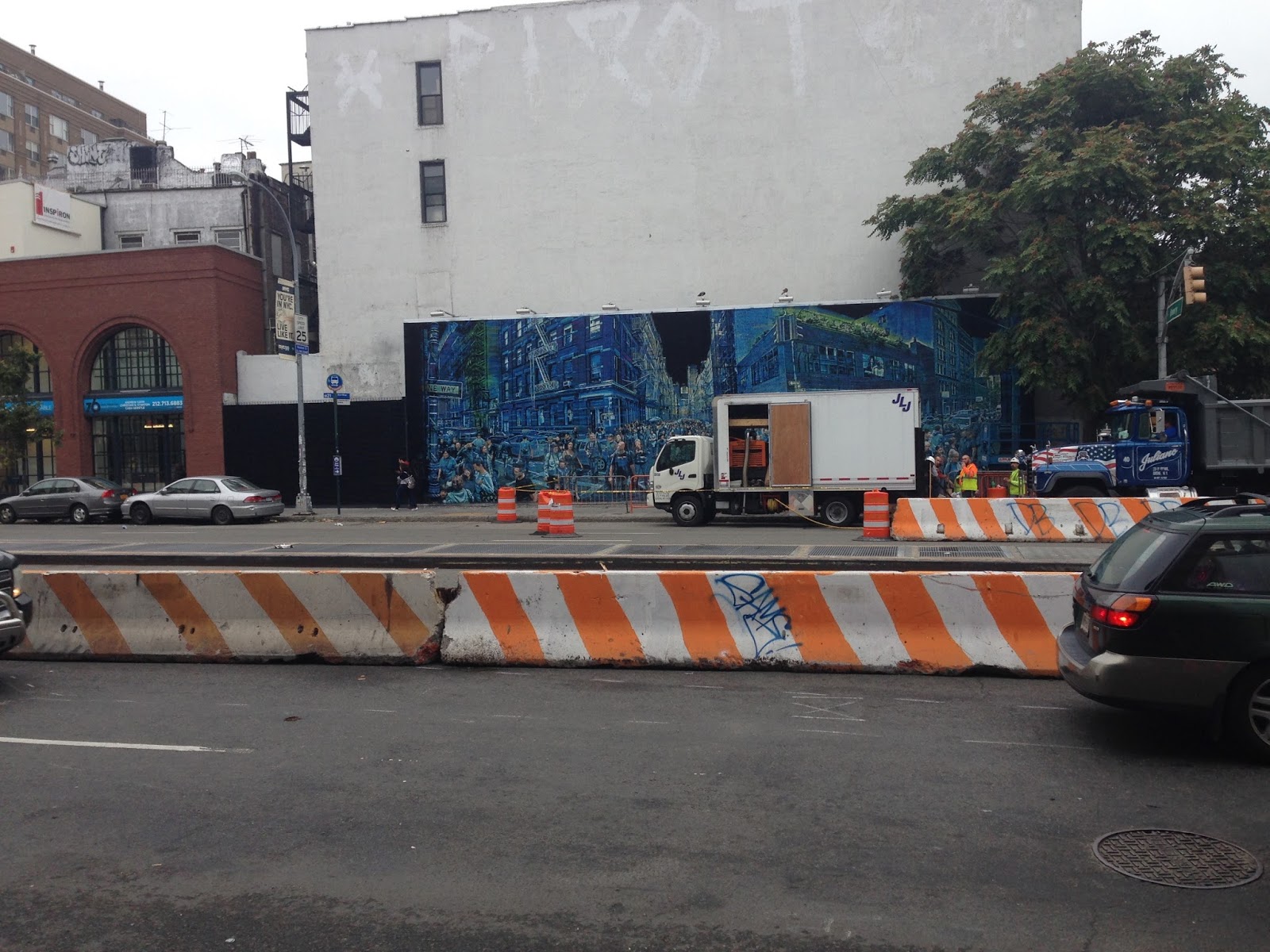
Anyway the highlight of this block is the Bowery Mural, which features a work by a different street artist about 2 or 3 times a year.
The latest work on the wall, which just went up in August, is by Logan Hicks.
According to Gothamist it is called "Story of My Life," and features people who are important to the artist.
It is sort of a panorama view of the nearby intersection of Spring and Greene Streets.
The wall has been owned by Goldman Properties since 1984, which has worked with Deitch Projects, an NYC art gallery, to use the wall as a rotating showcase for street artists since 2008.
Here is the wall on July 30 and August 1 of this year, between the latest transfer to a new artwork.
"another day another flower" was not a commissioned work on the wall, just someone writing on it. As far as I know, anyway.
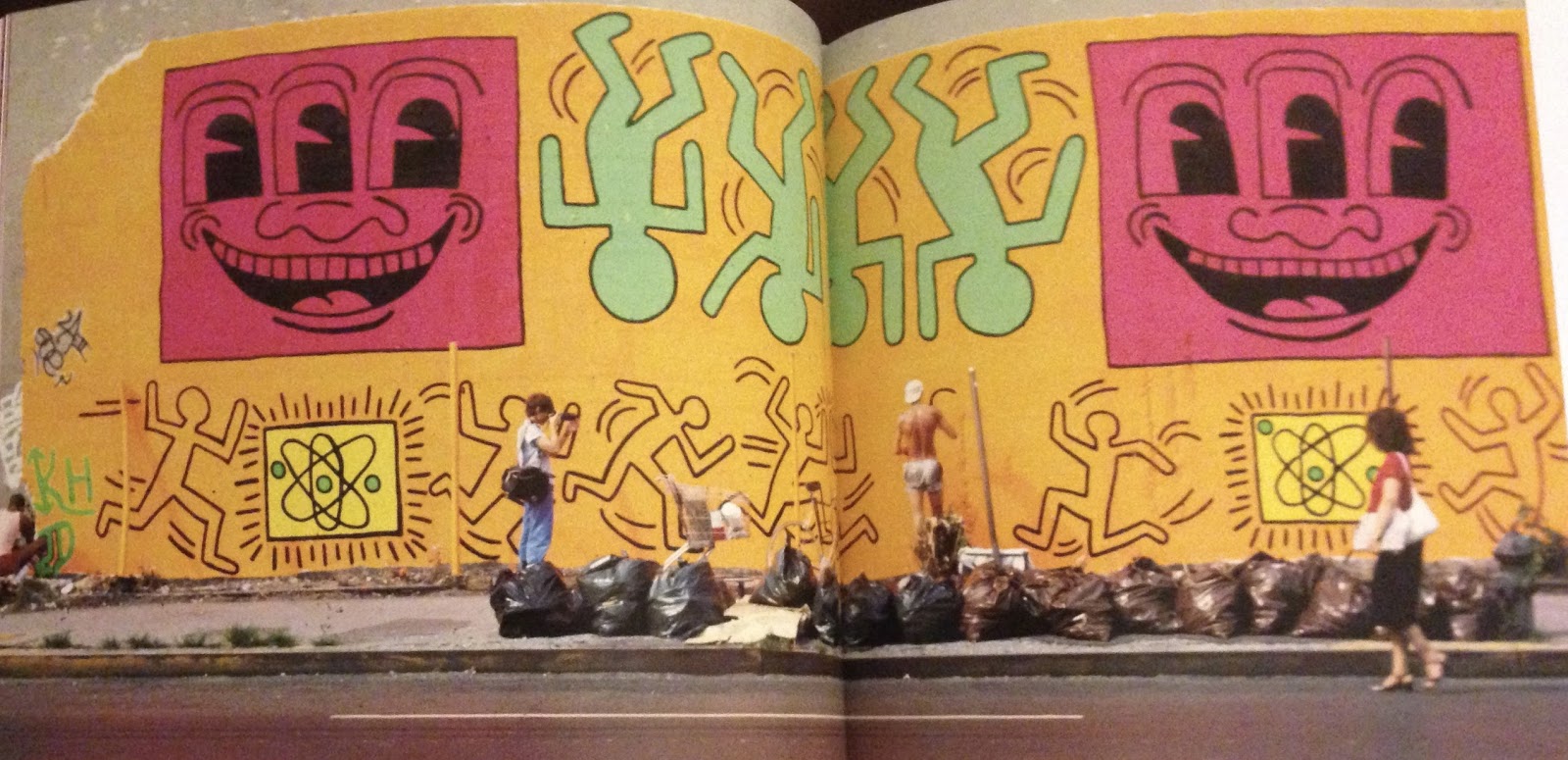
The first work of the project in 2008 was a tribute to Keith Haring's mural that he did on this wall in 1982 with his partner Juan Dubose.
Haring said that back then it was just a run-down area and former handball court, filled with garbage and practically abandoned, so he and Dubose cleaned it up and painted the wall white before Haring worked on it over about 2 days.
Here are some photos of the Haring mural being made in July 1982, with all the photos by Tseng Kwong Chi.
Pretty cool. There's something about Keith Haring's art that just pops with life and energy.
Before we (okay, I) get too romantic about this wall's connection with Keith Haring, it should be noted that Haring did not necessarily have a great experience overall with this project and the general area.
Some artists resented Haring for having left the East Village art scene and supposedly 'selling out,' so his mural was vandalized many times.
Haring fixed up his work initially but eventually just left it because it was happening too much and he also realized that he had to accept that he had done a work in a public space.
Then someone wrote across the whole mural '$9,999,' because Haring had said in an interview that he still hadn't sold anything for over $10,000. Haring said of this: "It was really too much to fix and was really too obnoxious. I painted the entire thing silver and destroyed it and said, 'Okay, f--- you, this is the end of the East Village.' I want nothing else to do with it. I'll never do another mural in the East Village."
I thought that was an interesting anecdote, especially because I think of Haring as such a celebrated downtown artist but didn't realize what he had to deal with. Especially from other downtown artists, which is really a shame.
(Keith Haring's memories of this mural project and the photos of it come from the great book "Keith Haring," by Jeffrey Deitch, Suzanne Geiss, and Julia Gruen)
By the way, according to the Bowery Boogie website, the Logan Hicks mural was vandalized by taggers just weeks after going up, and has since been cleaned up.
Despite unfortunate incidents of defacement, the mural wall makes this a significant block for downtown art, especially street art.
Hey, maybe the construction is also art, commenting on all of Manhattan seeming to be in repair and on the constant noise and clamor of modern city life. Maybe not.
I don't know if there's much to say about the rest of the block, but let's quickly go through some of it.
Next to the mural wall is a new building that seems to be for commercial space.
It's made of brick, and has arches... so that's cool. Hopefully it will house a bank or Duane Reade soon enough.
The other side of the street has some nice buildings with character that aren't too tall.
Under the scaffolding is a store called The Mobile Spa, which apparently is where phones get pampered.
Their locations include a store in NoHo and one in SoHo, in case you break your phone in between those few blocks.
An annoying thing about scaffolding is that it makes the sidewalks narrower, so that if you're in a hurry it's easier to get stuck behind a slow walker who you can't go around because of oncoming foot traffic.
On the other hand I was recently caught in a downpour with no umbrella and was suddenly grateful for all of the scaffolding in lower Manhattan to take refuge under. So scaffolding can be good, one or two days out of the year.
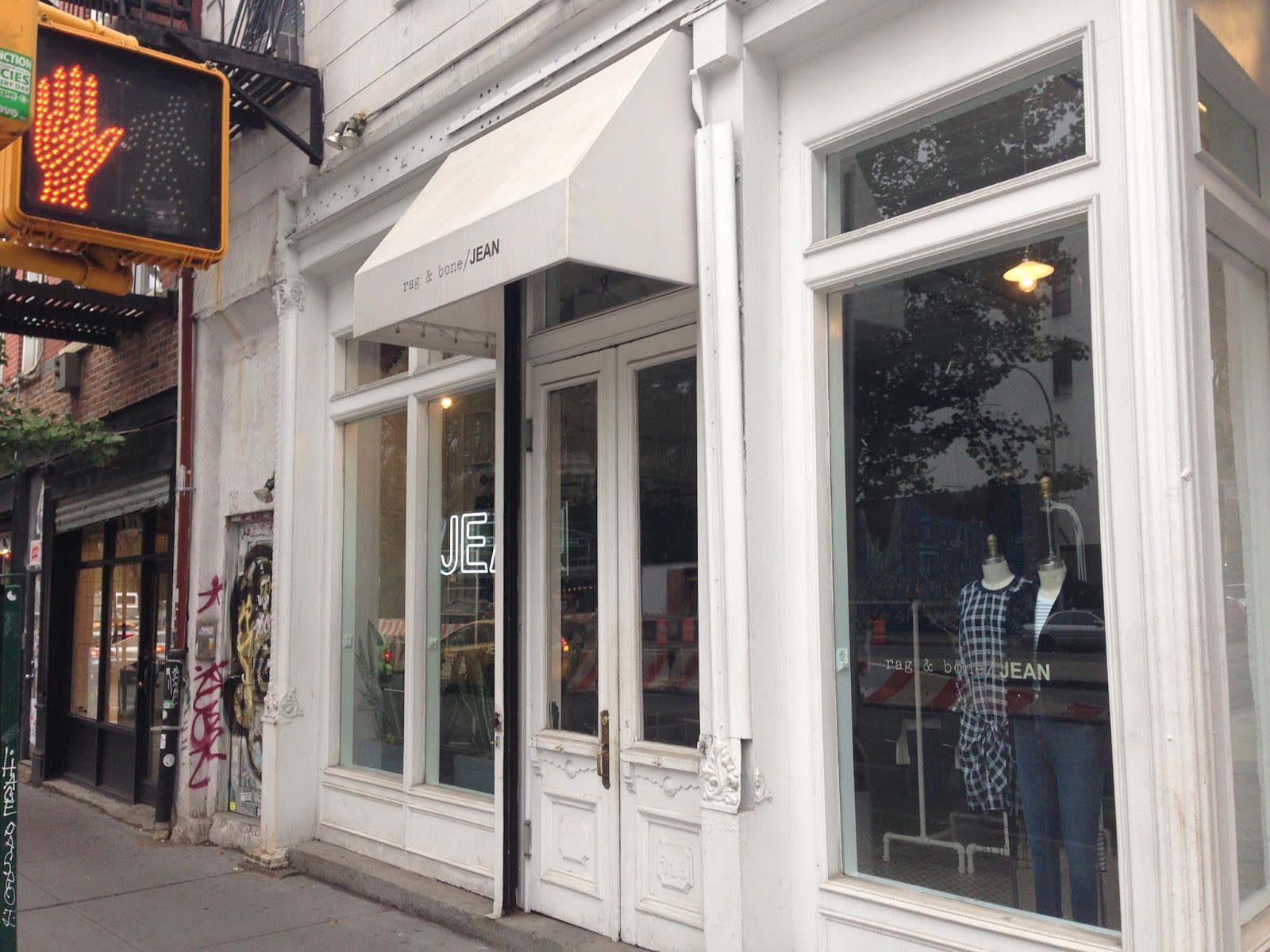
There seem to be 2 rag & bone clothing stores on the block. I would assume they are actually one connected shop but it looks like there's a shoe store in between, along with 2 doorways with graffiti-type stuff on them.
The one in this bottom photo is called rag & bone/JEAN, so maybe that offers more casual wear? I don't know, it's all a big mystery. Of course I could've gone in the stores to find out, but I didn't feel like it.
I guess that's all for this block. It's at a big crazy intersection but worth a visit for the Bowery Mural, and I hope you enjoyed the look at Keith Haring's painting as well. Thanks for reading.
This block may not have a lot of glamour-- okay it has almost no glamour-- but there are still some interesting things about it.
For example check out this empty lot!
It has some nice art on the back wall which may be related to more art that appears up the block on Clarkson Street near a school.
This space has been an empty lot for many years. I remember it being a good place as a kid to warm up before little league games while other games were finishing across the street in J.J. Walker Park.
But perhaps the most significant thing these days about this lot is that it is a proposed alternative site for affordable housing for those who want to save the Elizabeth Street Garden in Nolita.
I wrote about the garden in a previous post and how it is being considered as a site for such housing. Opponents of that plan, which seem to include most of the community and Community Board based on the news stories I've read, want to preserve the garden since there is very little green space in the neighborhood as it is.
This lot, while a bit removed from that neighborhood, would at least provide an alternative that would let the garden remain.
There was recently some bad news on this issue, as the city asked developers for bids regarding the garden space.
A press conference was held at the garden this past Wednesday, September 21, to protest this news. It had a big turnout, especially since it was in the early afternoon in the middle of the week.
Speakers included Tobi Bergman, who is Chair of the local Community Board and seen speaking in the above photo; Deborah Glick, a member of the State Assembly; and teachers from nearby PS1.
There is also a protest planned before a developer meeting in October.
So the struggle goes on to keep the garden intact, though it looks like an increasingly uphill battle. It's a shame since the Elizabeth Street Garden is a great sanctuary in Nolita, and because there's an empty lot just sitting on Hudson Street that could provide 5 times as much affordable housing as the garden space.
The other side of the street is one big brick building that houses several companies and organizations.
Along with the New York District Council of Carpenters, there is also the National Domestic Workers Alliance and the Dock Builders Local Union. And the Census Bureau!
There are also some radio stations, including Hot 97, WBLS, and RXP (The NY Rock Experience).
At the ground level there is a Baskin-Robbins and a Dunkin' Donuts. If you're trying to cut back on sugar you'll just have to go someplace else.
There are also WebMD offices in this building. If you're not familiar with WebMD, you type in your symptoms and then it scares you out of your mind. I guess if you don't want to do that on the internet, you can come here and they'll scare you in person.
Here's a look at some of Houston Street with the empty lot next to it.
Houston Street continues west and leads to the nearby West Side Highway, which Google Maps tells me is 9A though I've never heard it called that.
That's all I can think to write about this small block in the West Village which has a more industrial feel than other more artistic parts of the neighborhood. But it has some interesting and important elements to it, and thanks for reading this post.