Sometimes you just want to eat at a diner.
I'm even happy at mediocre diners, but the Square Diner in Tribeca is a good one. And it's a real diner, which unfortunately can be difficult to find in Manhattan. But there's still some out there.
They have fountain drinks and everything. I had a chocolate egg cream.
Throughout my life I haven't generally been familiar with the egg cream. We have been strangers, and that is mostly my doing. I think I've always found the name intimidating: is it like a milkshake, with milk and ice cream, but then they drop a raw egg in it? That doesn't sound appealing.
But an egg cream turns out to be milk, seltzer, and chocolate or vanilla syrup. Whoever came up with the name "egg cream" needed some marketing lessons. Or maybe just wanted all the egg creams to his or herself.
By the way, the Square Diner wonderfully has both the chocolate and vanilla egg cream options. I was tempted to go with vanilla, since I actually prefer vanilla for ice cream and milkshakes these days, but the chocolate somehow seemed more classic and I thought I should try that first.
The carbonated aspect took some getting used to but I really enjoyed it. I'm excited to try the vanilla one soon.
The food there was also terrific.
They weren't stingy with the pickles. Yes!
For me, the best part of a meal is that moment when everything is sitting there in front of you and you know you're about to have all that enjoyment. It's a nice feeling.
You may have noticed from one or two of the photos that I visited this block at night. Part of the reason was that it just worked out that way, but also I thought it would be a nice change and an experiment to see how the photos came out and how the mood of my experience was altered.
I must say I enjoyed the night mood during my visit. Even though the weather was pretty bad, with cold and rain and winds, nighttime in Manhattan can be a special place. It's a chance to walk around practically alone and in peace where so many thousands would be jostling during the day.
The rain can even add to the magical feel and create a dreamy effect in the photos, along with the streetlights' distortions.
Some fog in the sky added to the romanticism.
I remember being younger and listening to The Velvet Underground in my headphones as I walked through Manhattan at night in a cold drizzle, thinking, Now I better understand this music and this city. I imagine it would be like listening to The Doors in Los Angeles or reading Bukowski in, well, Los Angeles.
On the left side of the above photo, I found something oddly beautiful about the big empty construction site lit up at night.
Here are some looks at a thin island called Finn Square, across the street from the diner at the merging of Varick Street and West Broadway.
I assume that stand-alone object is a piece of art, but I'm not fully sure.
There is a Starbucks at the top right of the above photo. It is on the corner opposite the Square Diner on Leonard Street.
Starbucks is a coffee chain that offers regular and espresso coffees, with flavored options for the drinks and also some pastries. They have places to sit and... I just realized that my detailed description of what's in a Starbucks is probably unnecessary.
Along Leonard Street is the Juilliard Building.
Look out! There's a murderous donkey peering out one of the windows! On second thought it's probably just a stuffed animal. Still scary looking, though.
According to an article in The New York Times from 2000, several buildings were combined around that time to form a building of condominiums. It was named after Augustus D. Juilliard (1836-1919) because he and his wife Helen sold dry goods and had a warehouse there. He is the same person who the Juilliard School was named after, which is a school for the performing arts that he was a patron of. These buildings on Leonard Street date back to the 19th century.
Closer to the Hudson Street side of the block are two real estate companies. One is called Douglas Elliman Real Estate, established in 1911.
They had many properties displayed in their windows, but they were lit up so brightly that it actually hurt to look at them. In the photo they just look like rectangular lights. But I guess they know what they're doing since they've been around over 100 years.
On the other side of the street is Warburg, which was established in 1896. Wow, I was impressed by 1911, but 1896 is even better.
Here's the entrance around the corner on Hudson Street:
A little ways up on this building was some interesting metalwork, seen in the lower part of this photo:
I guess the address below wasn't good enough to get its own number:
How sad.
That's about it, here's one last look at the area with the Square Diner and Finn Square:
If you haven't done so already, please sign up at the top of the blog to get an e-mail notification every time I write a new post. And thanks for reading.
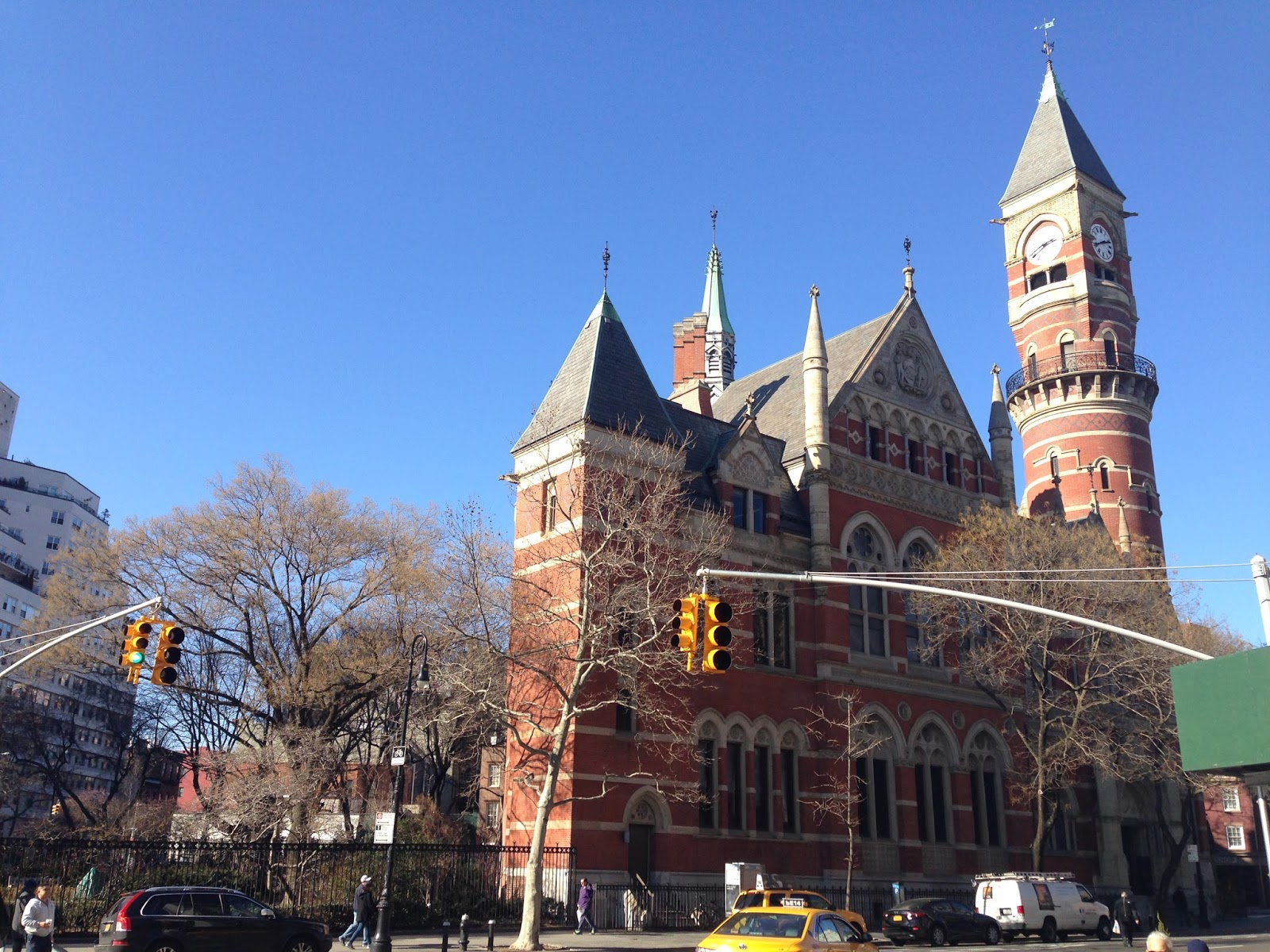
These days, the big building with the clock tower is the Jefferson Market branch of the public library, and the plot next to it is the Jefferson Market Garden. But this was not always the case. Oh no, my friend.
Jefferson Market actually used to be a market, starting in 1833. Which Jefferson was it named after? Don't overthink it... it was Thomas Jefferson. At the time there was also a firehouse, jail, and police court on that block.
The building that is now the library was originally a courthouse. It was built in 1877, as was the Jefferson Market Prison, which replaced the original jail.
The courthouse/library is a very beautiful and unique building, with many small and interesting details. Its style is called American Gothic.
In the above photo, there's something about those three rows of brick "steps" that I find interesting, plus the really small window above it.
They didn't have to throw that little owl in there, but they did, and it's adorable.
I don't know who the man inside the circle is, but this whole corner piece is really nice.
Here's the building entrance:
Above the Jefferson Market Branch sign, it still says on the building, "Third Judicial District Court-House":
Here are some views from across 6th Avenue:
Here is an illustration from the Historic American Buildings Survey of what the area looked like around 1880:
 The illustrator of the above image didn't throw in an elevated train down 6th Avenue just for some science-fiction fun; there did in fact used to be an el train there. More on that shortly.
The firehouse, jail, and market were all torn down in 1927 and replaced in 1931 with the 11-story Women's House of Detention, the only one in the city and the only jail ever built in the Art Deco style. When I was checking out the area, I met a man who knew a lot of the block's history, and he told me that in fact the women's jail was such a nice building that it actually raised property values in the area.
He also showed me a spot on the library building where the bricks are a different color, indicating the place where the courthouse and jail used to connect. You can see it straight ahead at the bottom of the building in this photo:
I used to think that the library building was a former church, because of its style and structure and also its stained glass windows. Here is a look just inside the building's entrance:
A spiral staircase leads to the 2nd floor, with beautiful windows along the way:
There are taller windows and a domed ceiling as you reach the second floor of the library:
I wasn't fully sure that it was okay to be taking photos inside the building, but it is a public library after all, so I'm hoping no one minds. I took one more picture inside a big reading room on the second floor, as secretly as possible, just in case:
Please don't be mad at me, public library. I'm a big fan. Everyone please support the NYPL!
Check out this photo below that was taken in 1935, and my attempt to show the same view in the present day:
 (Photo by Berenice Abbott)
In the 1935 photo, I'm assuming that the hint of a big building to the left of the courthouse is the 11-story Women's House of Detention.
That photo is also a good look at the 6th Avenue elevated train, which started in 1878 and ran from the southernmost parts of Manhattan in the financial district up to 58th street just south of Central Park. Above and below those areas, the line merged with the elevated Ninth Avenue train.
The photo with the el train gives me mixed emotions: on the one hand, it would be kind of cool and old-fashioned to still have an el train in lower Manhattan. On the other hand, the noise levels today often drive me crazy even without an elevated train added to the mix.
And in fact the noise and commotion caused by the el were part of the reason for it being closed in 1938 and torn down the next year. Maybe it's for the best that lower Manhattan only has below-ground trains these days.
The historian friend that I met gave me an interesting note to look into about the demolition of the el train: it turns out there were accusations that the metal materials from the demolished el were sold to the Japanese and then used to make some of their weapons in World War II. Despite official denials of this, the idea continued even several years after the war. E.E. Cummings even mentioned this idea in a poem called "plato told him," where he wrote of "a nipponized bit of/the old sixth/avenue/el..."
E.E. Cummings lived on the West 10th Street side of the Jefferson Market block, in an alley called Patchin Place. Several other writers have also lived there, along with Marlon Brando. Here's a look at Patchin Place and then West 10th Street:
The courthouse went into disuse in 1945 due to changes in the court system. The building was going to be razed in the late 1950's but was saved thanks to efforts by members of the community. In 1962 Mayor Robert F. Wagner, Jr. assented to make the building a library branch.
In 1973 the Women's House of Detention was torn down, largely due to complaints in the area about noise and disturbances. Friends and relatives of prisoners would stand outside of the building and yell to them, whether saying hello or relaying the goings-on. Other people would also gather in the area to observe all this happening. I can see how that would be a nuisance to people living nearby. Imagine if the el train was still around then too.
There were also issues of the House of Detention being overcrowded, and my historian friend said that at the top of the building was a hospital where doctors were doing bad things to people. He didn't specify but that sounded scary.
He also told me that in the Jefferson Market Garden today there are still sometimes found keys and other materials that date back to the jail.
Next to the Jefferson Market block, at the intersection of Sixth Avenue, Greenwich Avenue, and Christopher Street, is a small island of sidewalk called Ruth E. Wittenberg Triangle.
Ruth E. Wittenberg's 1990 obituary in The New York Times says she was an important person in preventing the courthouse from being torn down. She was also involved in the women's suffrage movement, which she went to jail twice for, and the civil rights movement, including participating in the Selma, Alabama march in 1965.
Across the street on 6th Avenue is C.O. Bigelow, which goes back to 1838 and says it is the oldest apothecary in the country. I like the faded advertisement on the building's wall:
According to its website, many famous people have been customers there throughout the years, including Thomas Edison, Eleanor Roosevelt, and Elvis Costello. I wonder how many times those 3 names have appeared in the same sentence.
To the right of C.O. Bigelow is LifeThyme, a really good store with natural foods and products.
It has two floors but overall a smaller, more local feel than Whole Foods.
I think that's it for this post. I don't know how well-known this block is in tourist circles, but I definitely think it's an historical highlight of lower Manhattan. Check it out if you're in the area.
Canal Street actually splits about a block before reaching the West Side Highway, so that there is a block where the two cross streets are Canal and Canal. I find that amusing for some reason.
Canal Park is in this spot, a small triangular plot with some trees and benches and not much else. It's nice, though.
Most of the trees were pretty bare, with it being February and all.
But there actually were some red berries.
I don't know what kind of berries they were but I assume they shouldn't be eaten. Don't eat strange berries, kids.
At 10pm everyone has to clear out. Actually there was no one else there when I stopped by:
It's good to know: if you want a Manhattan park to yourself, all you have to do is come here on a cold, overcast February day when it's unpleasant to be outside for too long, especially near the water where it's windy. Enjoy!
On the ground was a stone with some information:
Some of it might be hard to read in the photo, but at the top it says, "Established as public space in Dongan Charter by King James II 1686."
The Dongan Charter established Albany, New York as its own city. The governor of New York Province was Thomas Dongan. I couldn't find online mentions of the Charter making this area a public space, but I'll take the stone inscription's word for it.
Here's some of the original Charter:
 I guess that could really be a picture of any old document, but apparently it is some of the Dongan Charter.
Just in front of Canal Park, on the same island between all the traffic, is this little fellow:
Four of its sides have historical illustrations in the form of detailed, raised etchings that seem like they were made in a technologically advanced sort of way. You know, like with lasers and computers and stuff.
(I guess a bird didn't like that one too much.)
I wish there was still a flower market there. Maybe there is during the warmer months. I'll try to follow up on that.
I had no idea this little park went back so far. Pretty cool.
A few blocks east on Canal Street is the entrance to the Holland Tunnel, which opened in 1927 and goes under the Hudson River between Manhattan and New Jersey.
In fact, the Manhattan-bound lanes of the tunnel actually go directly under Canal Park. Another interesting thing I learned is that these buildings below are two of four ventilation structures that take carbon monoxide out of the tunnel:
(When I was looking at the building above I thought it might be a cell phone tower, but I think the ventilation thing is much more interesting.)
Thomas Edison believed that ventilating a tunnel with so much traffic would not be possible, but the engineer Ole Singstad figured out a way to do it. I must admit, if Edison said a project couldn't be done, I would pack up my things and head home. Way to go, Ole Singstad.
It is admittedly not very quiet around Canal Park, being surrounded by a highway and tunnel traffic.
But it's nice that it's right next to the water. Even in Manhattan there is a draw to finding the island's edges to be closer to the water, as Herman Melville wrote more eloquently than I ever could.
Please stay on this side of the railing, kid. We don't want a "Superman II" situation on our hands.
Here's a blurry seagull:
There were a bunch of seagulls in the area. Do seagulls not migrate in the winter? Maybe that was a dumb question.
I believe there are chairs and benches in between these trees during the warmer months, but I guess the city removes them in the winter because no normal person would want to sit out there now. I was sitting on a nearby short wall while I took this photo, by the way.
I guess someone figured, 'If I could just take these signs off, then I could remove all the furniture I want.' Or maybe they just said 'screw it' and stole the furniture. Hey, maybe that's actually why there's no furniture there now. This could be turned into a mystery novel. A very, very trivial mystery novel.
Speaking of mysteries, I wasn't sure what this nearby building was:
Maybe it was a cousin of the fashion company DKNY? It turns out that DSNY is the Sanitation Department. The flags were at half-staff, perhaps for the recent death of Justice Antonin Scalia.
Here's some other buildings nearby along the West Side Highway:
Call me old-fashioned, but I don't like the modern, mostly-glass look of many newer buildings. I don't know how old that red building in the middle is, but I wish newer buildings were more like that, with a more earthy look to them.
I do like these purple and green tiles:
And the blue basketball court:
That about wraps it up from Tribeca. Have I mentioned before that Tribeca stands for Triangle Below Canal? Well, it does. So I guess that technically makes this block just above Tribeca. Hmm.
One last note: At the top of the website on the right, I added an option to follow this blog through e-mail. If you like the blog, please submit your e-mail address there and verify through the e-mail it will send you. Then you'll be notified every time I write a new post. Thanks, and thanks for reading.